
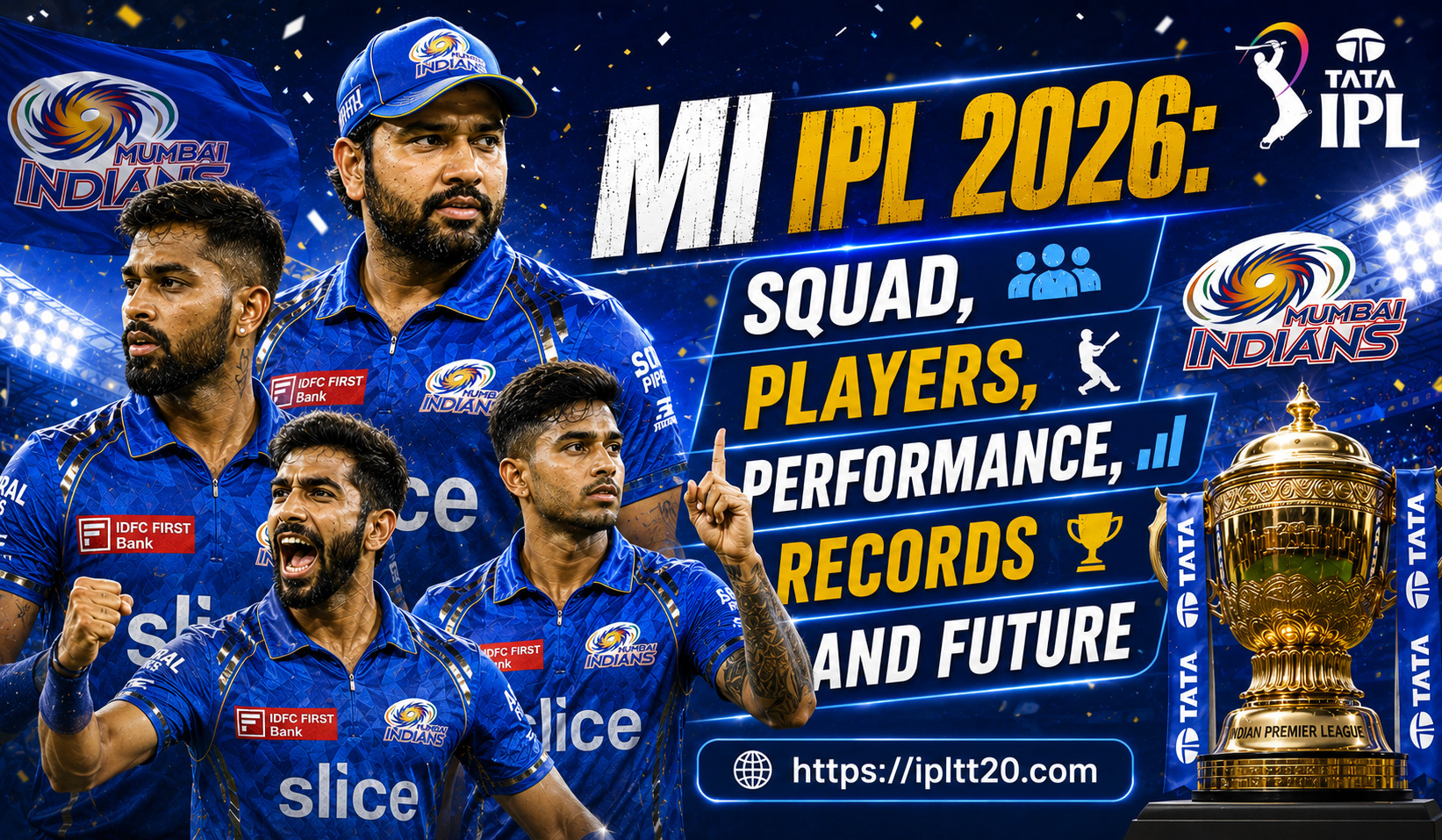

Mumbai Indians entered IPL 2026 with a powerful combination of experienced stars, established international players and promising young talent. The five-time champions had plenty of quality in their squad, but the season proved to be a challenging one. Led by Hardik Pandya, MI relied on the experience of Rohit Sharma, Jasprit Bumrah and Suryakumar Yadav while also looking toward players such as Tilak Varma, Ryan Rickelton and Naman Dhir.
The 2026 campaign was ultimately disappointing for Mumbai. The team struggled to maintain consistency throughout the league stage and finished outside the playoff positions. However, the season also highlighted several players who could become important to the franchise’s future.
For a team with such a successful history, one difficult season does not change its overall standing. Instead, IPL 2026 provided Mumbai Indians with an opportunity to identify weaknesses, develop younger players and plan for their next competitive era.
MI IPL 2026 Squad
Mumbai Indians entered the season with a balanced squad covering batting, bowling, wicketkeeping and all-round options.
| Player | Role |
| Hardik Pandya | All-rounder, Captain |
| Rohit Sharma | Batter |
| Jasprit Bumrah | Fast Bowler |
| Suryakumar Yadav | Batter |
| Tilak Varma | Batter |
| Trent Boult | Fast Bowler |
| Deepak Chahar | Fast Bowler |
| Will Jacks | All-rounder |
| Naman Dhir | All-rounder |
| Ryan Rickelton | Wicketkeeper-Batter |
| Mitchell Santner | All-rounder |
| Shardul Thakur | All-rounder |
| Sherfane Rutherford | Batter |
| Corbin Bosch | All-rounder |
| Robin Minz | Wicketkeeper-Batter |
| Allah Ghazanfar | Spinner |
| Mayank Markande | Spinner |
| Ashwani Kumar | Fast Bowler |
| Raghu Sharma | Bowler |
| Raj Angad Bawa | All-rounder |
The squad provided several combinations for different playing conditions. MI could strengthen their batting, add more pace or use additional spin depending on the opposition.
Hardik Pandya as Captain
Hardik Pandya continued as Mumbai Indians captain in IPL 2026.
His leadership remained an important part of the team’s strategy. Hardik had already experienced success as captain with Gujarat Titans before returning to Mumbai, but leading MI brought a different kind of pressure.
Mumbai have five IPL titles, and supporters expect the franchise to compete for the championship every season.
Hardik therefore had to manage a team containing several senior stars while also giving younger players opportunities.
His contribution as an all-rounder was equally important. He could provide valuable runs in the middle order and contribute with the ball when required.
However, his overall numbers in 2026 were below the level expected from one of MI’s key players. He scored 206 runs and took four wickets, making it difficult for the team to receive the full all-round impact it needed.
Rohit Sharma’s Role
Rohit Sharma remained an important part of Mumbai Indians’ batting group.
Although he was no longer captain, his experience continued to be valuable. Rohit has been part of the franchise’s most successful era and understands the demands of playing high-pressure IPL matches.
He played nine matches during the season and scored 283 runs. His aggressive approach remained visible, with a strike rate above 157.
Rohit’s ability to attack during the powerplay gives Mumbai an important advantage when he gets settled.
His presence also provides younger players with the opportunity to learn from one of the most experienced batters in the team.
Suryakumar Yadav’s 2026 Campaign
Suryakumar Yadav had a difficult season compared with his outstanding previous campaign.
He scored 270 runs in 13 innings. His strike rate remained impressive, but his average dropped significantly.
SKY’s importance to Mumbai comes from his ability to dominate the middle overs.
He can score boundaries in unconventional areas and attack both pace and spin. When he is in form, he can completely change the momentum of a match within a few overs.
However, MI needed greater consistency from him in 2026.
His reduced run production placed additional pressure on the other members of the batting lineup.
Tilak Varma’s Progress
Tilak Varma was one of the brighter aspects of Mumbai’s season.
The left-handed batter scored 359 runs in 14 innings and maintained a strike rate close to 146. He also produced a century and two half-centuries.
Tilak’s ability to perform in the middle order makes him particularly valuable.
He can rebuild an innings when early wickets fall but can also accelerate when the team needs quick runs.
For Mumbai, his continued development is extremely important.
As the franchise gradually prepares for the future, Tilak could become one of the central players around whom the next generation is built.
Ryan Rickelton’s Impact
Ryan Rickelton emerged as one of MI’s strongest batting performers in 2026.
He scored 448 runs in 12 innings, averaging more than 40 and striking at over 186.
His aggressive batting provided Mumbai with valuable momentum.
Rickelton’s performances were especially useful because the team’s established Indian batters did not consistently produce their best numbers.
His contribution demonstrated how important overseas players can be when they deliver regularly throughout a long IPL campaign.
Naman Dhir’s Development
Naman Dhir also provided encouraging performances.
He scored 318 runs during the season at a strike rate above 147.
His ability to attack in the middle and lower-middle order gave MI another option when they needed quick runs.
For a franchise planning beyond its established stars, the development of players such as Dhir is important.
Young players who can contribute consistently allow teams to maintain squad depth while reducing their dependence on a small group of star performers.
Jasprit Bumrah: MI’s Bowling Leader
Jasprit Bumrah remained the central figure in Mumbai’s bowling attack.
His ability to bowl effectively during every phase of an innings makes him one of the most valuable players in T20 cricket.
He can take wickets with the new ball, control the middle overs and deliver difficult overs at the death.
Bumrah has also become one of the most successful bowlers in Mumbai Indians history.
His consistency has helped the franchise compete against some of the strongest batting lineups in the tournament.
However, the 2026 campaign demonstrated that even a world-class bowler needs reliable support.
Mumbai needed other bowlers to create consistent pressure alongside him.
Trent Boult’s Experience
Trent Boult provided another experienced fast-bowling option.
His left-arm angle gives Mumbai variety, particularly during the powerplay.
Boult’s ability to swing the ball early can put opposition batters under pressure before they have time to settle.
A bowling combination featuring Bumrah and Boult has the potential to be extremely effective.
The challenge for MI is ensuring that the rest of the bowling attack can maintain pressure after the opening overs.
MI’s Overall Performance in 2026
Mumbai Indians finished the 2026 season outside the playoffs.
The campaign was marked by inconsistent performances rather than a complete lack of quality.
There were matches in which individual players produced outstanding performances, but the team struggled to put together complete performances across batting and bowling.
That inconsistency proved costly during the league stage.
For a franchise accustomed to competing deep into the tournament, missing the playoffs represented a significant setback.
MI’s Batting Performance
Mumbai’s batting produced several positive individual performances.
Ryan Rickelton led the team’s run-scoring, while Tilak Varma and Naman Dhir also crossed the 300-run mark.
Rohit Sharma and Suryakumar Yadav contributed runs but were unable to maintain the consistency expected from them.
The problem was therefore not simply a lack of batting talent.
Instead, MI struggled to get multiple batters performing at their best during the same period.
T20 cricket often depends on momentum, and Mumbai could not consistently create it.
MI’s Bowling Concerns
Bowling was another area that required improvement.
Bumrah continued to provide high-quality performances, but the supporting attack was not always consistent.
Mumbai had experienced options such as Boult, Deepak Chahar and Shardul Thakur, along with younger bowlers.
The team needed a more reliable combination capable of taking wickets during the powerplay and controlling the death overs.
Building greater bowling depth should therefore be one of the franchise’s priorities going forward.
MI’s Historic IPL Records
Mumbai Indians remain one of the most successful franchises in IPL history.
They have won five championships, with their title victories coming in 2013, 2015, 2017, 2019 and 2020.
The franchise has also produced several legendary players.
Rohit Sharma became one of the most successful captains in IPL history, while Jasprit Bumrah developed into one of the world’s leading fast bowlers.
Mumbai’s ability to repeatedly rebuild competitive squads has become one of the defining features of the franchise.
The Role of Wankhede Stadium
Wankhede Stadium has always been an important part of the Mumbai Indians identity.
The venue generally offers batting-friendly conditions, allowing aggressive stroke play.
MI’s players have developed significant familiarity with the ground, which can provide an advantage during home matches.
However, successful IPL teams need to perform consistently both at home and away.
The 2026 campaign showed that Mumbai needed greater balance across all conditions.
Lessons From IPL 2026
The biggest lesson for Mumbai was that star power alone cannot guarantee success.
The team had several world-class players, but performances were not consistent enough across the squad.
MI need greater depth and clearly defined roles.
They also need to continue developing young Indian players so that the franchise has replacements ready when senior stars eventually move on.
The 2026 season can therefore become a useful learning experience rather than simply a disappointing campaign.
MI’s Future
Mumbai Indians now face several important decisions regarding their future.
The franchise must balance its established stars with emerging talent.
Hardik Pandya’s leadership will remain an important topic, particularly after a difficult season.
The team also needs to decide how best to manage the later stages of Rohit Sharma’s career while preparing younger batters to take greater responsibility.
Bumrah will remain central to the bowling attack, but MI need to build a strong supporting unit around him.
Building the Next Generation
Young players are likely to play an increasingly important role in Mumbai’s future.
Tilak Varma already appears capable of becoming a long-term middle-order leader.
Naman Dhir has shown that he can contribute aggressively, while other emerging players provide additional depth.
Mumbai have historically been successful at identifying young talent.
Continuing that tradition will be crucial if the franchise wants to remain competitive over the next several seasons.
What MI Must Improve
The franchise can focus on several key areas:
- Greater consistency from the middle order.
- More dependable support for Jasprit Bumrah.
- Clearer roles for emerging players.
- Stronger performances away from home.
- Better balance between experienced and young players.
- Effective leadership and tactical planning.
Addressing these areas could help Mumbai recover quickly from their disappointing 2026 campaign.
Conclusion
MI IPL 2026 was a challenging season for one of the IPL’s most successful franchises.
Hardik Pandya continued as captain, while Rohit Sharma, Suryakumar Yadav and Jasprit Bumrah remained important members of the experienced core. At the same time, Ryan Rickelton, Tilak Varma and Naman Dhir provided encouraging performances.
The biggest issue was consistency.
Mumbai possessed enough individual talent to compete, but they struggled to produce complete team performances regularly. Their batting had several strong contributors, while Bumrah continued to lead the bowling attack, but the supporting cast needed greater reliability.
Despite the disappointing season, Mumbai Indians still have a strong foundation for the future.
Bumrah remains one of the world’s premier fast bowlers, Tilak Varma represents the next generation, and the franchise has a long history of developing young talent.
IPL 2026 should therefore be viewed as a setback rather than the end of Mumbai’s competitive era. The franchise has rebuilt successfully before, and its next challenge will be to use the lessons from this season to create another balanced and ambitious team.
For Mumbai Indians, the future will depend on combining the experience of established stars with the energy and potential of a new generation. If that balance is achieved, MI can once again become a serious contender for the IPL trophy.