
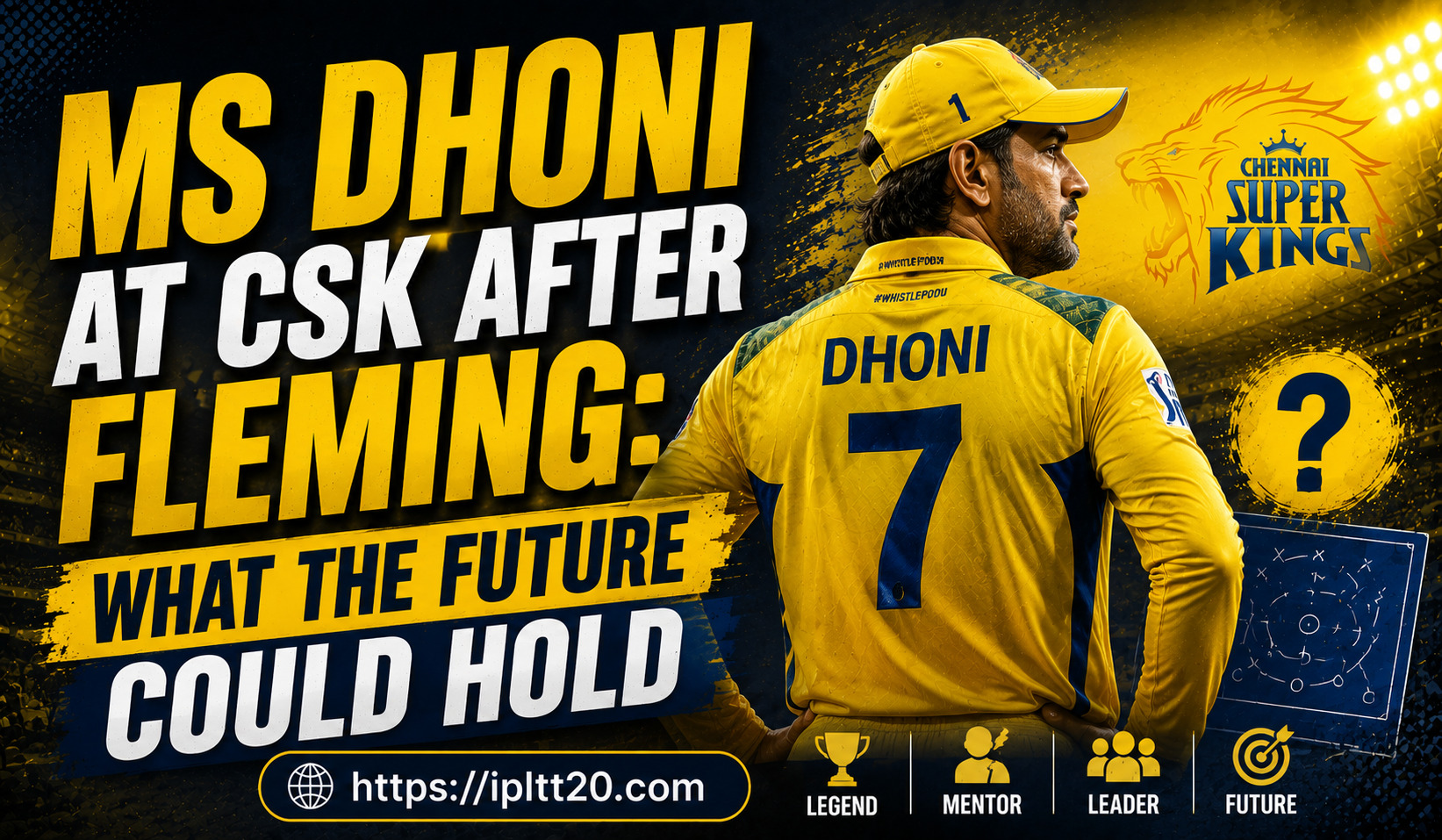

MS Dhoni and Chennai Super Kings have been connected for almost two decades, creating one of the strongest player-franchise relationships in Indian Premier League history. Since becoming CSK’s first captain in 2008, Dhoni has played a central role in shaping the team’s identity, leadership culture and success.
The end of Stephen Fleming’s long association with Chennai Super Kings has created a new chapter for the franchise. Fleming and Dhoni worked together for years, developing a calm and highly successful system. With the coaching structure now entering a transition period, questions are naturally being raised about Dhoni’s future role at CSK.
The biggest question is no longer simply whether Dhoni will continue playing. It is also about how much influence he could have in the franchise’s next phase and whether he could become a mentor, strategic adviser or part of the team’s broader cricket management structure.
MS Dhoni and CSK: A Historic Partnership
MS Dhoni has been the face of Chennai Super Kings since the beginning of the IPL.
When CSK entered the tournament in 2008, Dhoni was appointed captain. His leadership quickly became one of the team’s biggest strengths.
Under his captaincy, CSK developed a reputation for consistency, tactical intelligence and composure under pressure. The franchise regularly reached the playoffs and became one of the most successful teams in IPL history.
Dhoni’s leadership style was different from the aggressive approach associated with some other captains. He generally remained calm, trusted his players and was willing to make unconventional decisions when situations demanded them.
That approach became part of CSK’s identity.
The Dhoni-Fleming Era
The partnership between Dhoni and Stephen Fleming was particularly important.
Fleming handled the coaching side while Dhoni remained the team’s primary on-field decision-maker.
The two complemented each other.
Fleming brought planning, preparation and a deep understanding of T20 cricket, while Dhoni provided match-day leadership and tactical instincts.
Together, they created a system in which players generally understood their roles.
This stability became one of CSK’s biggest advantages.
The end of Fleming’s tenure therefore represents more than a coaching change. It removes one half of a partnership that shaped CSK for many years.
What Happens to Dhoni After Fleming?
The future role of Dhoni could take several forms.
He could continue as a player, take on a stronger mentoring responsibility or eventually move into a non-playing position within the franchise.
His exact role will depend on his fitness, motivation and the direction chosen by CSK management.
However, even if Dhoni eventually stops playing, his knowledge of the franchise is too valuable to ignore.
He understands the team’s culture, its supporters, its former players and the pressures associated with leading CSK.
That experience could become particularly important during a period of transition.
Could Dhoni Continue as a Player?
The possibility of Dhoni continuing as a player remains one of the most discussed topics among CSK supporters.
Age and physical demands are obvious considerations.
T20 cricket requires quick movement, explosive batting, athletic fielding and the ability to recover between matches.
For a player at Dhoni’s stage of his career, managing workload becomes increasingly important.
However, his value cannot be measured only through batting statistics.
Dhoni brings wicketkeeping experience, tactical awareness and enormous knowledge of match situations.
His role could therefore become increasingly specialized.
Rather than being expected to play the same role he did during his peak years, he could potentially contribute in a more targeted capacity.
Dhoni as a Mentor
One of the most natural future roles for Dhoni is mentor.
Young CSK players can benefit enormously from having an experienced former captain around them.
Dhoni has played against generations of international cricketers and has experienced almost every situation possible in professional T20 cricket.
He understands how players respond to pressure, how matches change momentum and how small tactical decisions can influence results.
A mentoring role would allow him to pass this knowledge to the next generation.
This could be especially valuable as CSK transition toward a younger squad.
Ruturaj Gaikwad and the Next Generation
Ruturaj Gaikwad represents an important part of CSK’s future.
The franchise has already given him leadership responsibility, and he is expected to become one of the central figures of the team’s next era.
Dhoni can potentially play an important role in supporting Gaikwad’s development.
Leadership is difficult to learn entirely from textbooks or statistics. Experience is often gained through difficult matches, mistakes and pressure situations.
Dhoni’s guidance could help Gaikwad understand how to manage players, communicate with coaches and make decisions under pressure.
The goal would not be for Gaikwad to copy Dhoni.
Instead, he could develop his own leadership style while learning from one of the most successful captains in IPL history.
Dhoni’s Role in the Post-Fleming Setup
The new coaching structure could benefit from Dhoni’s involvement even if he is not formally part of the coaching staff.
He could act as a bridge between the players and management.
Because he has spent so many years within the franchise, Dhoni understands how CSK traditionally operate.
At the same time, the new coaching team will bring fresh ideas.
Dhoni could therefore help ensure that modernization does not completely disconnect the franchise from its established identity.
This balance could be extremely important.
Could Dhoni Become a Cricket Adviser?
Another possibility is a strategic or advisory role.
CSK could eventually use Dhoni’s experience in areas such as recruitment, player development, match strategy and leadership.
An adviser does not necessarily need to be involved in daily coaching.
Instead, the role could involve contributing to major cricketing decisions.
His understanding of T20 cricket could be valuable during player retention discussions and auction planning.
Dhoni has seen how successful teams are built and how quickly a strong squad can become outdated if succession planning is ignored.
The Importance of Youth Development
CSK’s future will depend heavily on younger players.
The franchise has traditionally relied on experienced cricketers, but the modern IPL increasingly rewards teams with athletic and versatile young players.
Dhoni can help younger players understand the demands of professional cricket.
He can also teach them how to handle the pressure that comes with representing a high-profile franchise.
This mentorship could be particularly useful for young wicketkeepers and middle-order batters.
Dhoni and Wicketkeeping Development
Wicketkeeping is another area where Dhoni could have a major influence.
He is one of the most experienced wicketkeepers in professional cricket.
Young keepers can learn from his positioning, glove work, communication with bowlers and understanding of field placements.
Even if Dhoni eventually stops keeping wickets for CSK, he could remain an important resource for developing the franchise’s next wicketkeeper.
This could help CSK avoid a sudden leadership and wicketkeeping vacuum when Dhoni finally retires.
What CSK Could Learn From Dhoni’s Leadership
Dhoni’s leadership legacy offers several lessons for CSK’s future.
The first is the importance of trusting players.
He has often given cricketers responsibility rather than immediately dropping them after one poor performance.
The second is maintaining calm under pressure.
IPL seasons are long, and teams inevitably face losing streaks and difficult situations.
The third is role clarity.
Players perform better when they understand what is expected of them.
These principles can continue even after Dhoni stops playing.
CSK’s Need for a New Identity
Although Dhoni’s influence remains enormous, CSK cannot depend on one individual forever.
Every successful sports franchise eventually needs to move into a new generation.
The challenge for CSK is creating a future identity that does not rely entirely on Dhoni’s presence.
Ruturaj Gaikwad could become part of that transition.
Younger players will also need to take greater responsibility.
The coaching staff must create its own philosophy while preserving the values that have worked for CSK.
Dhoni’s role should therefore be about facilitating the transition rather than preventing it.
Could Dhoni Become CSK’s Long-Term Mentor?
A long-term mentoring position could be one of the most logical options.
It would allow Dhoni to remain connected with the franchise while giving younger leaders room to develop.
He could work with the captain, coaching staff and players without necessarily being involved in every tactical decision.
Such a role would also make use of his experience without placing the physical demands of professional cricket on him.
For CSK, retaining his knowledge within the organization could be highly valuable.
The Emotional Side of Dhoni’s Future
There is also a powerful emotional connection between Dhoni and CSK supporters.
For many fans, Dhoni is synonymous with the franchise.
His departure from playing cricket will therefore be an emotional moment.
However, the best way to honor his legacy may not be keeping him on the field indefinitely.
Instead, CSK could gradually transition him into a role where he helps prepare the franchise for the next generation.
That would allow his influence to continue without making the team dependent on him.
What If Dhoni Retires?
If Dhoni eventually announces his retirement from IPL cricket, CSK will face one of the biggest transitions in their history.
The team would lose an experienced wicketkeeper, finisher and tactical leader.
But retirement would not necessarily mean complete separation.
Dhoni could remain involved behind the scenes.
His experience could help the franchise identify future leaders and prepare for major squad changes.
The transition would still be difficult, but careful planning could reduce its impact.
The Future of CSK After Dhoni
The post-Dhoni CSK era will ultimately depend on the franchise’s ability to create a new leadership group.
Ruturaj Gaikwad could be central to that process.
Other senior players will also need to take responsibility.
The coaching staff must develop younger talent and create a modern playing style.
The franchise can preserve its culture without trying to recreate the exact team that dominated the IPL during the Dhoni era.
That distinction will be important.
A New Chapter Rather Than an Ending
The departure of Fleming and the eventual end of Dhoni’s playing career should not necessarily be viewed as the end of CSK’s successful identity.
Instead, it can represent a new chapter.
Fleming’s coaching principles can continue to influence the franchise, while Dhoni’s leadership lessons can be passed to younger players.
The next generation can then develop its own approach.
Successful teams survive because their systems evolve.
CSK’s biggest challenge will be ensuring that the transition happens gradually rather than waiting until its senior players are no longer available.
Conclusion
MS Dhoni’s future at Chennai Super Kings remains one of the most fascinating storylines surrounding the franchise.
His relationship with CSK has already produced an extraordinary legacy, including multiple IPL championships and years of consistent performances.
With Stephen Fleming’s era coming to an end, Dhoni’s experience could become even more valuable.
Whether he continues as a player, becomes a mentor, takes on an advisory role or eventually steps away from the franchise, his influence is likely to remain part of CSK’s identity.
The most important responsibility now is succession planning.
Ruturaj Gaikwad and other younger players need opportunities to establish themselves as the next generation of CSK leaders. A new coaching structure must also introduce modern ideas while preserving the team’s strongest traditions.
Dhoni can play a significant role in that transition.
His greatest contribution to CSK’s future may ultimately not be another match-winning innings. It could be helping the franchise build a team capable of succeeding without him.
The post-Fleming era therefore presents CSK with both a challenge and an opportunity. With careful planning, Dhoni’s experience can become a bridge between the franchise’s remarkable past and a new generation that could define its future.