
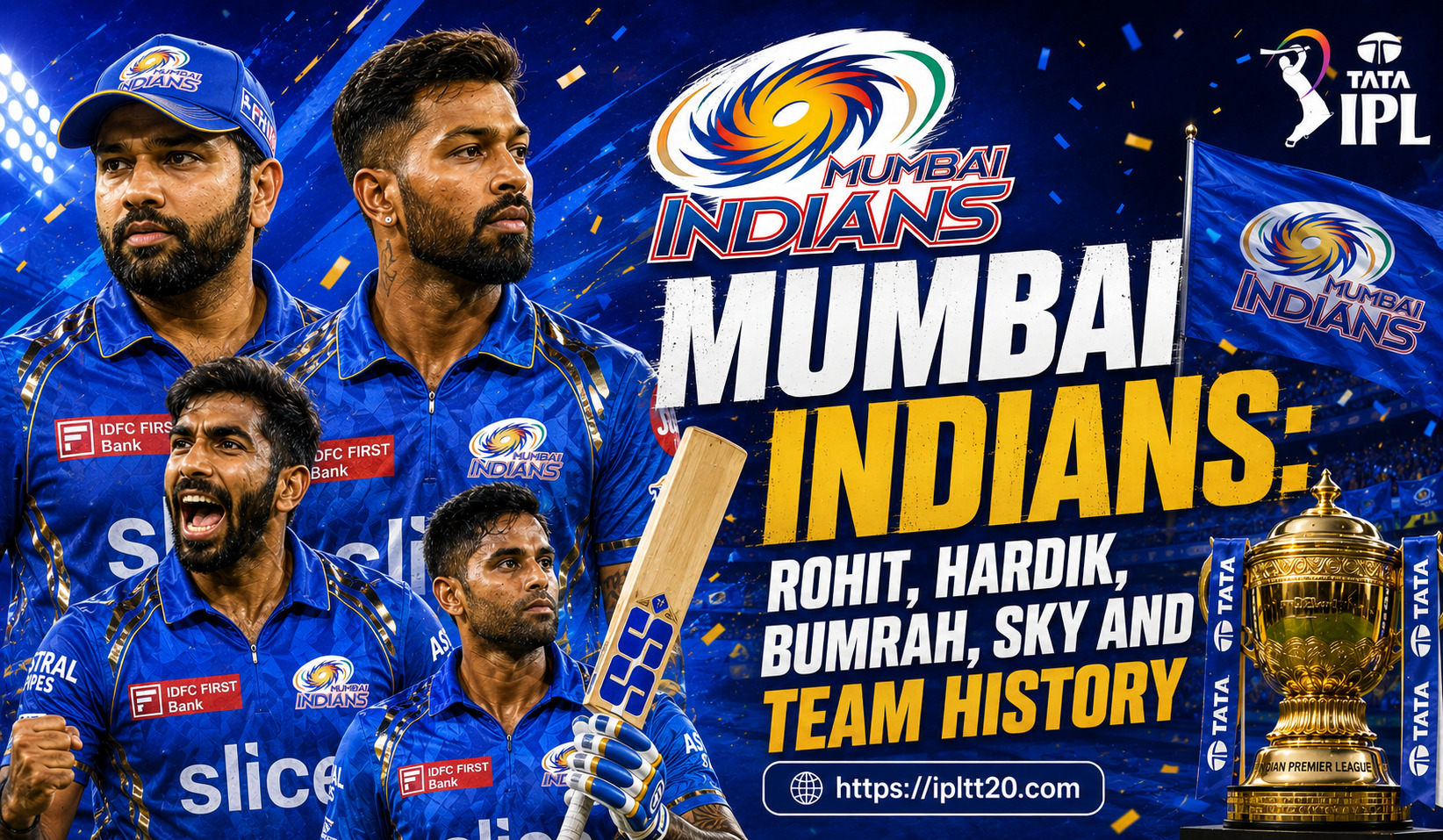

From their early struggles to becoming a five-time champion, MI have built a legacy around elite players, strong leadership, smart recruitment and the ability to perform under pressure.
Over the years, several players have become closely connected with the Mumbai Indians identity. Rohit Sharma transformed the franchise as captain, Jasprit Bumrah developed into one of the world’s leading T20 bowlers, Suryakumar Yadav became one of the most exciting batters in the league, and Hardik Pandya evolved from a young talent into an important all-rounder and captain.
The story of Mumbai Indians is therefore not simply a story of trophies. It is a story of players who helped create different successful eras and a franchise that has repeatedly rebuilt itself around a strong core.
Mumbai Indians’ Beginning in the IPL
Mumbai Indians were among the original franchises when the IPL began in 2008. Representing one of India’s biggest cricketing cities, the team entered the competition with enormous expectations.
The early years, however, were not particularly successful.
MI had talented players but struggled to find the right combination. Their performances were inconsistent, and the franchise needed time to develop an identity.
The arrival of key players and changes in leadership eventually transformed the team.
The biggest turning point came when Rohit Sharma became captain.
Rohit Sharma and the Transformation of MI
Rohit Sharma’s association with Mumbai Indians became one of the most important chapters in IPL history.
He joined the franchise in 2011 and was appointed captain in 2013. Under his leadership, Mumbai quickly developed into a championship-calibre side.
Rohit’s captaincy combined tactical flexibility with a willingness to trust players.
He also played an important role with the bat. His ability to score heavily at the top of the order gave MI a reliable foundation.
The results were remarkable.
Mumbai won their first IPL title in 2013, beginning one of the most successful periods in franchise cricket.
Mumbai Indians’ Five IPL Titles
Mumbai Indians have won five IPL championships, with their victories coming in 2013, 2015, 2017, 2019 and 2020.
| Year | Result |
| 2013 | Champions |
| 2015 | Champions |
| 2017 | Champions |
| 2019 | Champions |
| 2020 | Champions |
The five championships established MI as one of the dominant teams of the IPL.
Interestingly, the franchise often followed a cycle of rebuilding and returning stronger. Rather than relying on the same players forever, MI developed a reputation for identifying replacements and giving young cricketers opportunities.
The 2013 Breakthrough
The 2013 season was a turning point.
Mumbai had previously struggled to convert strong squads into consistent results. Under Rohit’s leadership, the team finally found the balance it needed.
MI defeated Chennai Super Kings in the final to claim their first IPL championship.
The victory gave the franchise confidence and established a winning culture.
It also marked the beginning of Rohit’s remarkable record as an IPL captain.
The 2015 Championship
Mumbai returned to the final two years later and secured their second IPL trophy.
The team defeated Chennai Super Kings in the championship match.
By this stage, MI had developed a powerful combination of experienced players and emerging talent.
The franchise’s ability to build strong squads around a stable core was becoming increasingly obvious.
The 2017 Final Thriller
The 2017 IPL final remains one of the closest championship matches in tournament history.
Mumbai Indians faced Rising Pune Supergiant and successfully defended a low total in a dramatic contest.
MI won by just one run.
The result demonstrated one of the defining characteristics of the franchise: the ability to remain composed during extremely difficult situations.
That narrow victory also strengthened the team’s reputation as a side capable of winning close matches.
Back-to-Back Championships
Mumbai’s most impressive period came in 2019 and 2020.
The franchise won the 2019 title after another thrilling final against Chennai Super Kings.
In 2020, MI successfully defended their championship and became a five-time IPL winner.
The 2020 team was particularly well balanced.
Rohit provided leadership and top-order batting, while Bumrah led a powerful bowling attack. Players such as Hardik Pandya, Kieron Pollard and others contributed in different areas.
The result was one of the strongest teams in the franchise’s history.
Jasprit Bumrah: From Young Talent to Superstar
Jasprit Bumrah’s journey with Mumbai Indians is one of the best examples of the franchise’s talent-development system.
Bumrah joined MI in 2013 as a relatively unknown domestic cricketer.
Over time, he developed into one of the most dangerous fast bowlers in world cricket.
His unusual action, accuracy, pace variations and ability to bowl at the death made him a perfect fit for T20 cricket.
Bumrah became an important part of Mumbai’s championship teams and eventually became the leader of India’s pace attack as well.
His development demonstrates how MI have often identified talent before it becomes widely recognized.
Bumrah’s Importance to the Team
Mumbai’s success has been closely connected with the quality of their bowling attack.
Bumrah’s ability to bowl in different phases makes him particularly valuable.
He can take wickets with the new ball, control the middle overs and deliver difficult yorkers at the death.
His consistency has also allowed MI to use other bowlers more aggressively.
Instead of depending on every bowler to deliver the same role, Mumbai can build an attack around Bumrah’s reliability.
That tactical flexibility has been one of the team’s biggest strengths.
Suryakumar Yadav: The Rise of SKY
Suryakumar Yadav became another important part of Mumbai’s modern identity.
After returning to MI, he developed into one of the most dangerous T20 batters in the world.
SKY’s batting style is unusual because he can score boundaries in areas that traditional batters rarely target.
His ability to play behind square, over the field and through gaps makes him difficult for bowlers to contain.
He also has the ability to change the momentum of a match within a few overs.
His growth at MI eventually translated into a major role for India.
SKY’s Role in the MI Batting Lineup
Suryakumar’s importance comes from his versatility.
He can attack spin during the middle overs and take on fast bowlers when they miss their lengths.
His ability to score quickly means MI can maintain a high run rate even after the powerplay.
This makes him particularly valuable in modern T20 cricket, where teams increasingly look for batters who can score at a rapid pace throughout an innings.
His performances have also made him one of the most recognizable players associated with Mumbai Indians.
Hardik Pandya’s MI Journey
Hardik Pandya has had a complicated but important relationship with Mumbai Indians.
He first emerged as a young all-rounder with the franchise and quickly became an important part of their championship-winning teams.
His explosive batting, powerful hitting and ability to bowl useful overs made him a valuable player.
Hardik later moved to Gujarat Titans, where he became captain and led the franchise to the IPL title in its debut season.
His return to Mumbai marked another major chapter.
He was appointed captain, taking over the leadership role from Rohit Sharma.
Hardik as MI Captain
Hardik’s appointment created significant discussion among supporters because Rohit had led MI to five IPL championships.
Taking over such a successful franchise was always going to be challenging.
Hardik had to establish his own leadership style while managing a dressing room filled with senior players.
His all-round abilities also make him important to team balance.
When Hardik contributes with both bat and ball, MI gain an additional tactical option.
His leadership journey remains an important part of Mumbai’s modern history.
Rohit, Hardik, Bumrah and SKY: The Core
Few franchises have had a group of players as influential as Rohit Sharma, Hardik Pandya, Jasprit Bumrah and Suryakumar Yadav.
Each player represents a different aspect of Mumbai’s success.
Rohit represents leadership and experience.
Bumrah represents elite bowling.
SKY represents modern attacking batting.
Hardik represents all-round ability and leadership.
Together, they have helped define different phases of MI’s development.
Mumbai’s Other Legendary Players
The franchise’s history also includes several other major names.
Kieron Pollard became one of the most important overseas players in MI history. His finishing ability and powerful hitting helped Mumbai win numerous matches.
Lasith Malinga was another key figure.
The Sri Lankan fast bowler became famous for his deadly yorkers and was one of the most important members of Mumbai’s early championship teams.
Harbhajan Singh also played a significant role, particularly with his experience and spin bowling.
These players helped establish the foundation on which the modern MI team was built.
MI’s Talent Development System
One of Mumbai’s greatest strengths has been its ability to develop young players.
Bumrah is the most famous example, but the franchise has also helped players such as Hardik Pandya, Krunal Pandya, Suryakumar Yadav and Tilak Varma develop into major cricketers.
The franchise has traditionally looked beyond established names.
Scouting and player development have therefore become important parts of the MI strategy.
This approach allows the team to refresh its squad when experienced players eventually move on.
The Importance of Tilak Varma
Tilak Varma represents the next generation of Mumbai Indians.
The left-handed batter has shown impressive maturity despite his relatively young age.
His ability to play in the middle order gives MI an important left-handed option.
Tilak can build an innings when wickets fall early and accelerate when the team needs quick runs.
His development will be particularly important as Mumbai gradually transitions from its older core to a younger generation.
MI’s Team Culture
Mumbai Indians’ success cannot be explained only through individual players.
The franchise has created a culture focused on preparation, professionalism and long-term development.
Players are generally given clear responsibilities.
Experienced cricketers guide younger teammates, while emerging players are encouraged to take responsibility.
This system has helped MI remain competitive across different IPL eras.
Records and Achievements
Mumbai Indians’ five IPL titles are the most obvious achievement, but their history includes many other milestones.
The team has repeatedly reached the playoffs and finals while producing some of the league’s most successful players.
Rohit Sharma became one of the most successful captains in IPL history, while Bumrah developed into a leading fast bowler.
The franchise has also established itself as one of the strongest teams in high-pressure knockout matches.
The Future of Mumbai Indians
The future of MI will depend on how effectively the franchise manages its transition.
Rohit Sharma’s playing career is moving toward its later stage, while Bumrah and SKY remain central to the team’s competitive ambitions.
Hardik’s leadership will also remain important.
At the same time, players such as Tilak Varma and other younger cricketers must gradually take greater responsibility.
The challenge is to preserve the standards established during the franchise’s most successful years while creating a new generation of leaders.
Conclusion
Mumbai Indians’ IPL history is a story built around exceptional players and strong team culture.
Rohit Sharma transformed the franchise into a championship powerhouse, leading MI to five IPL titles. Jasprit Bumrah grew from a young prospect into one of the world’s leading fast bowlers. Suryakumar Yadav developed into an elite T20 batter, while Hardik Pandya became an explosive all-rounder and later took on the captaincy.
Behind these stars were players such as Lasith Malinga, Kieron Pollard, Harbhajan Singh and many other important contributors who helped shape Mumbai’s identity.
The franchise’s five championships in 2013, 2015, 2017, 2019 and 2020 demonstrate its remarkable consistency.
But MI’s biggest achievement may be its ability to continually evolve.
The Rohit era created a championship culture. Bumrah and SKY became pillars of the next phase, while Hardik represents another important chapter in leadership.
With young talents such as Tilak Varma emerging, Mumbai Indians have the opportunity to build another successful generation.
The history of MI shows that stars may change, captains may change and squads may evolve, but the franchise’s ambition remains the same: compete at the highest level and create another championship chapter in its remarkable IPL story.